
Gangnam Style AI Prompt: the Exact Trio Night-Selfie Prompt
The full reference-to-video prompt behind Oraclip’s Gangnam Style AI page, with what it needs, why each line is there and tips to run it yourself.
 Oraclip Team
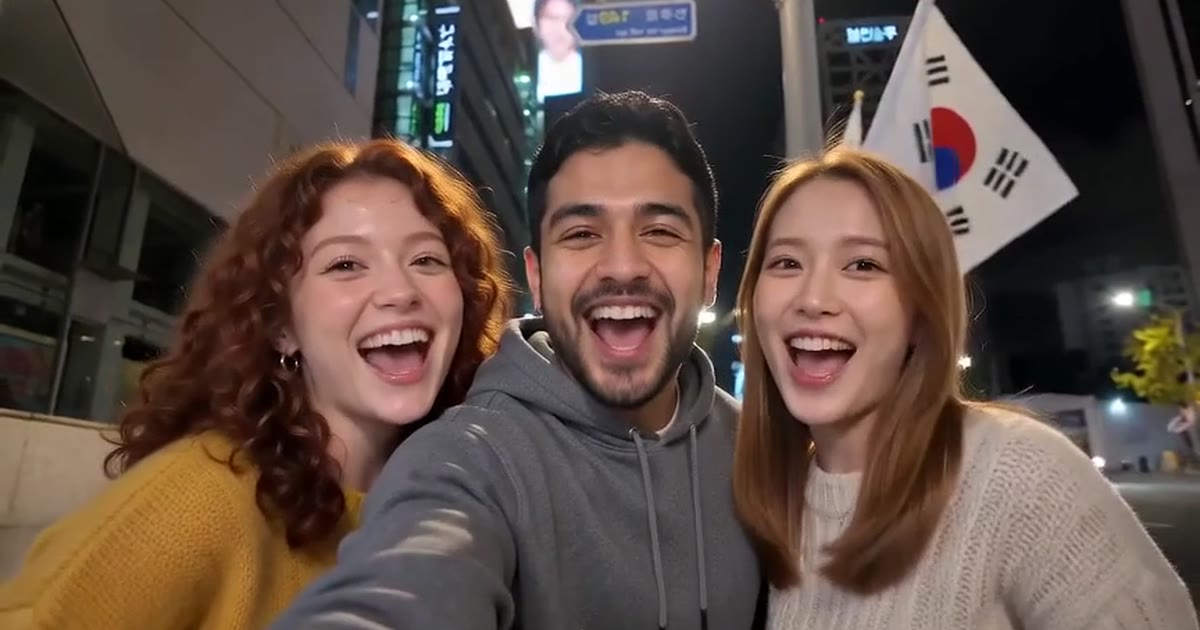
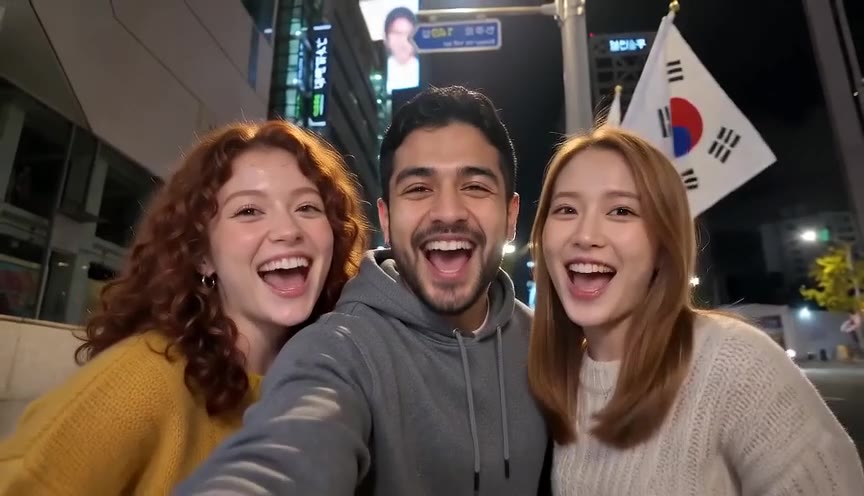
This is the exact prompt behind Oraclip's Gangnam Style AI page, the one that puts three friends into the viral "gangnam style in gangnam" night selfie. Copy it if you want to run it yourself in a reference-to-video model, or just use the page, which fills in your three photos, the 15-second trend clip and a licensed beat for you.
Skip the setup: Gangnam Style AI →
What the prompt needs
- @video1: a 15-second cut of the trend clip (group selfie, three solos, palm to the lens). The page uses its own reference cut; we don't hand out the clip.
- @image1, @image2, @image3: one adult per photo, face visible, in solo order. @image1 is the friend with the phone, who opens and closes the video.
- A model that takes images and a video together. The page runs Seedance 2.0 Mini (reference-to-video) at 480p or 720p.
The Gangnam Style AI prompt (16:9)
Recreate @video1 shot for shot as a new horizontal 16:9 video. @video1 is a 15 s cut of a real night-time front-camera selfie video filmed on a street in Gangnam, Seoul: office towers with lit windows, street lamps, passing cars and South Korean flags on tall poles. Use @video1 only for the camera moves, shot order, framing, timing, gestures and the street; never copy any face, hair, body or outfit from it. The three friends are new people. The first friend, who holds the phone and stands in the middle, is the person in @image1 in EVERY shot: the exact face from @image1 (face shape, eyes, eyebrows, nose, mouth, skin tone, age, hair colour, length and style, and any beard, glasses or freckles) and the clothes from @image1. The second friend, beside the first in the group selfie, is the person in @image2 in EVERY shot: the exact face from @image2 (face shape, eyes, eyebrows, nose, mouth, skin tone, age, hair colour, length and style, and any beard, glasses or freckles) and the clothes from @image2. The third friend, on the other side of the first, is the person in @image3 in EVERY shot: the exact face from @image3 (face shape, eyes, eyebrows, nose, mouth, skin tone, age, hair colour, length and style, and any beard, glasses or freckles) and the clothes from @image3. Shots, matching @video1 second by second: 0-1.5 s the three squeeze into one arm's-length selfie, laughing and singing along; 1.5-4.5 s close-up of the first friend (the one holding the phone) singing to the lens and pointing past it; 4.5-7.8 s the second friend alone by the road, a hair flip, a hand on the chest and a wave; 7.8-8.3 s fast whip pan; 8.3-11.8 s the third friend alone in front of a glass lobby, both hands in the hair, then a hand flicked at the lens; 11.8-15 s back to the first friend under the flags, an open palm pushed toward the lens, then a big smile to the camera. Exactly three performers, each one consistent from the first frame to the last, so their friends recognise them at once; they never trade places, never merge, never morph and never drift back to the women of @video1. One head per person, five fingers per hand. Strangers far behind stay small and blurred. Mouths move loosely as if singing along and cheering, no clear words. Photoreal handheld phone footage at night, natural skin, sharp faces, light motion blur only in the whip pan. No text, captions, subtitles, logos, watermark, no fourth friend, no celebrities, no children.
For vertical 9:16, the page swaps the first sentence for: "Recreate @video1 shot for shot as a new vertical 9:16 full-screen phone video, the three close enough to share the frame in the group selfie." Everything else stays the same.
Why it is written this way
- "Use @video1 only for the camera moves…; never copy any face": the biggest failure in early tests was the model leaking one of the original women into the final shot. Naming exactly what to take from the clip, and what not, keeps it to the three new people.
- A full identity line per photo: listing face shape, hair and clothes for each @image makes each friend stay the same person from the first frame to the last.
- Second-by-second shots: the trend is recognisable by its order (selfie, phone friend, road, whip pan, lobby, palm), so the prompt pins every beat to the clip's timing.
- "Mouths move loosely… no clear words": the soundtrack is added afterwards, so lips should read as singing along, not as speech.
- "No celebrities, no children": the page also checks every photo before charging and refuses minors, public figures and film characters.
Tips if you run it yourself
- Use three single-person photos. Group photos confuse who goes where.
- Keep the reference clip at 15 seconds or less and cut it so it ends on the palm, not on a group shot with the original people.
- Don't blur faces in the reference clip: the model copies the blur.
- Add your sound after generating, cut the same way as the reference clip so the lyrics land on the same shots. The page does this for you with the trend’s original sound (PSY’s "Gangnam Style" as heard in the original post; the song belongs to its rights holders and is not licensed to users) and also gives you a silent copy to post with TikTok’s sound.
Prices on the page: 370 credits (Std 480p) or 760 credits (HD 720p) for 15 seconds, in 16:9 or 9:16. Step-by-step guide: How to make the Gangnam Style AI video.